Helicopter Design and Components
Helicopter components
Rotor Systems
All helicopters must have some type of rotor system to produce lift. Here are are the different rotor systems:
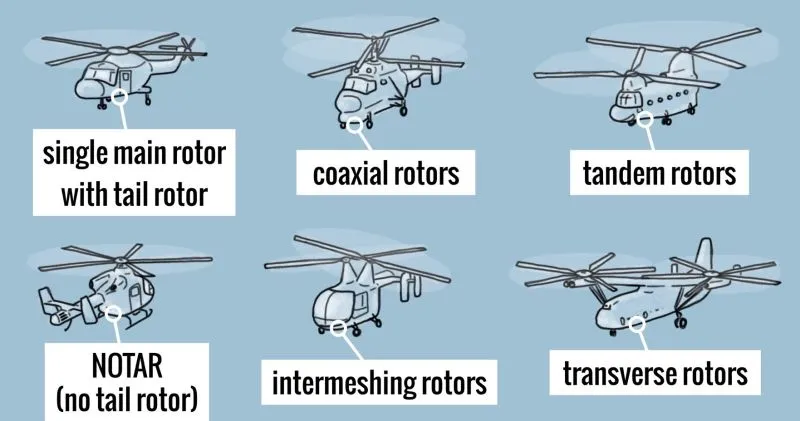
The main rotor system is crucial for all helicopters, as it is what allows helicopters to fly. In the Robinson 22 (R22), we have a semi-rigid (teetering) main rotor system. Let's break down what that means, but first we need to introduce some concepts:
- Feathering, is the blade's ability to twist around its longitudinal axis. This is done mechanically.
- Flapping, is the blade's ability to move up and down, either independently or together with another blade in the rotor system. This can be done mechanically, or the blade is built to bend or flex.
- Lead/Lag, is the blade's ability to move forward and aft of its neutral position. This can also be done mechanically, or the blade is built to allow for this motion via bending and flexing.
The R22, as mentioned earlier has a semi-rigid (teetering) main rotor system. This means the blades can:
- Feather via the swashplate assembly.
- Flap, when one blade moves up the other blade moves down, like a seesaw.
There are a few other main rotor systems out there, here is a table overview of their features and pros/cons:
| Type | Feather? | Flap? | Lead/Lag? | Pros | Cons |
|---|---|---|---|---|---|
| Rigid (Hingeless) | Yes | Yes | No | Responsive, low complexity, less moving parts | Expensive |
| Semi-rigid | Yes | Yes | No | Low cost, cheaper to maintain, low complexity | Prone to mast-bumping. |
| Fully articulate | Yes | Yes | Yes | Smooth ride | Complex, expensive |
A tail rotor is necessary in a R22 due to the torque produced by the main rotor system. Torque is a byproduct from the turning of the main rotor. Newton's Third Law states that:
For every reaction there is an equal and opposite reaction.
So if our main rotor turns counter-clockwise, then we will have a turning moment clockwise.
If we look at some of the other rotor systems like coaxial and tandem, the two main rotors turn in opposite directions removing the need for a tail rotor, or anti-torque system.
The R22's tail rotor is referred to as a traditional tail rotor system, however other anti-torque systems exists:
- Traditional,
- Fenestron,
- NOTAR ()
-Transmission; main and tail
-Swashplate assembly
-Drive train and tail boom
Transmission of a R22
-Clutch; centrifugal, friction drive
Powerplant
The engine in an R22 is a Lycoming O-360-J2A reciprocal piston engine.
Principles Piston vs. Turbine
Piston engines work using a four-stroke cycle.
- Suck, as piston moves down it sucks in air/fuel mixture
- Squeeze, piston moves up and compresses air/fuel mixture
- Bang, air/fuel mixture is ignited and we have combustion
- Blow, force from combustion pushes piston down and exhaust out of cylinder.
Magneto system
Help the spark plugs, left magneto also helps when we start the engine.
Flight controls
-Cyclic
-Collective
-Throttle
-Pedals
Electrical system
The R22 has a 14V DC electrical system, with an alternator and a sealed lead-acid battery (12V). Alternator control unit protects the electrical system from overvoltage conditions.
- Battery
-Generator
-Circuit breakers, can pop and be pushed back in unlike fuzes which are a one and done situation.
-Aircraft lights; navigation/position, anti-collision, landing lights
Fuel and fuel system
-Proper grade fuel, 100LL. If wrong type can cause detonation and incomplete burn of fuel in cylinders.
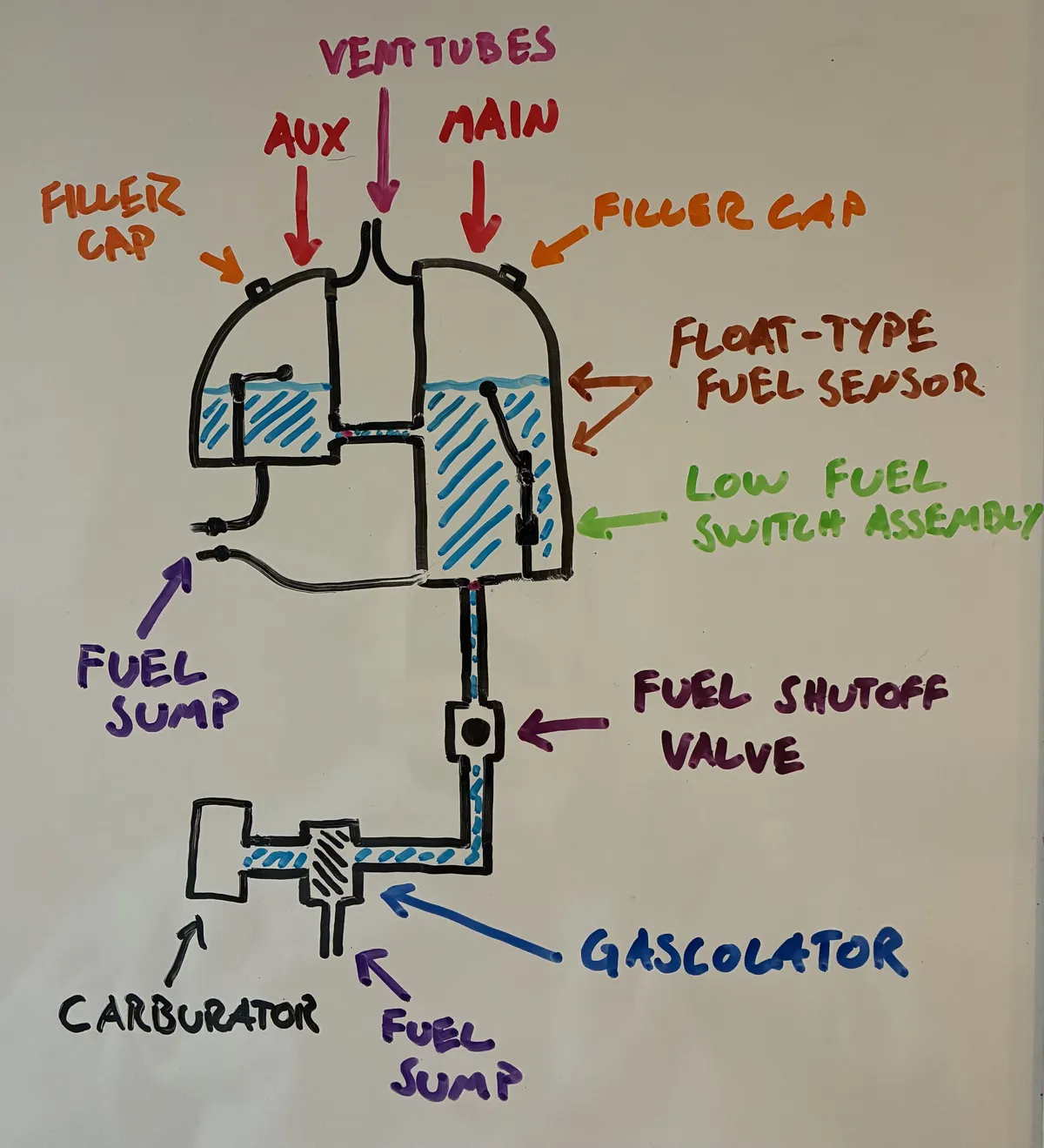
-Fuel system operation, gravity fed.
-Fuel contamination; preventive measures, elimination
of contamination in fuel
-Refueling procedures and grounding
Fuel system seen from the front of a R22.
Oil and oil system, hydraulic system if appropriate
-Oil; type and quantity
Ashless dispersant oil, SAE15W50. Or Mineral oil if you are breaking in the engine.
Why use oil? 4 reasons, lubricate, cool, remove particles, provide a tight seal between piston head and cylinder wall.
-Oil system operation, dry vs wet sump. We have a wet sump.
- oil collects in oil sump under engine
- is sucked by pump towards the cooler
- if oil too hot, then cooled. if not then moves past cooler
- into filter
- pressure measurement
- pressure release valve
- into engine
- repeat
-Hydraulic system; type, hydraulic fluid used, servicing
we have it in the 44, not really important for now. Helps alleviate pressure on controls for pilot.
Instruments
-Function, markings, and limitations
-Dual tachometer, separate circuit. powered via battery, then clock then to the tachs. Engine gets readings from magneto, rotor from MR gear box drive "flange"?
-Manifold pressure gauge, measured behind butterfly valve
Flight instruments, function, markings, and limitations
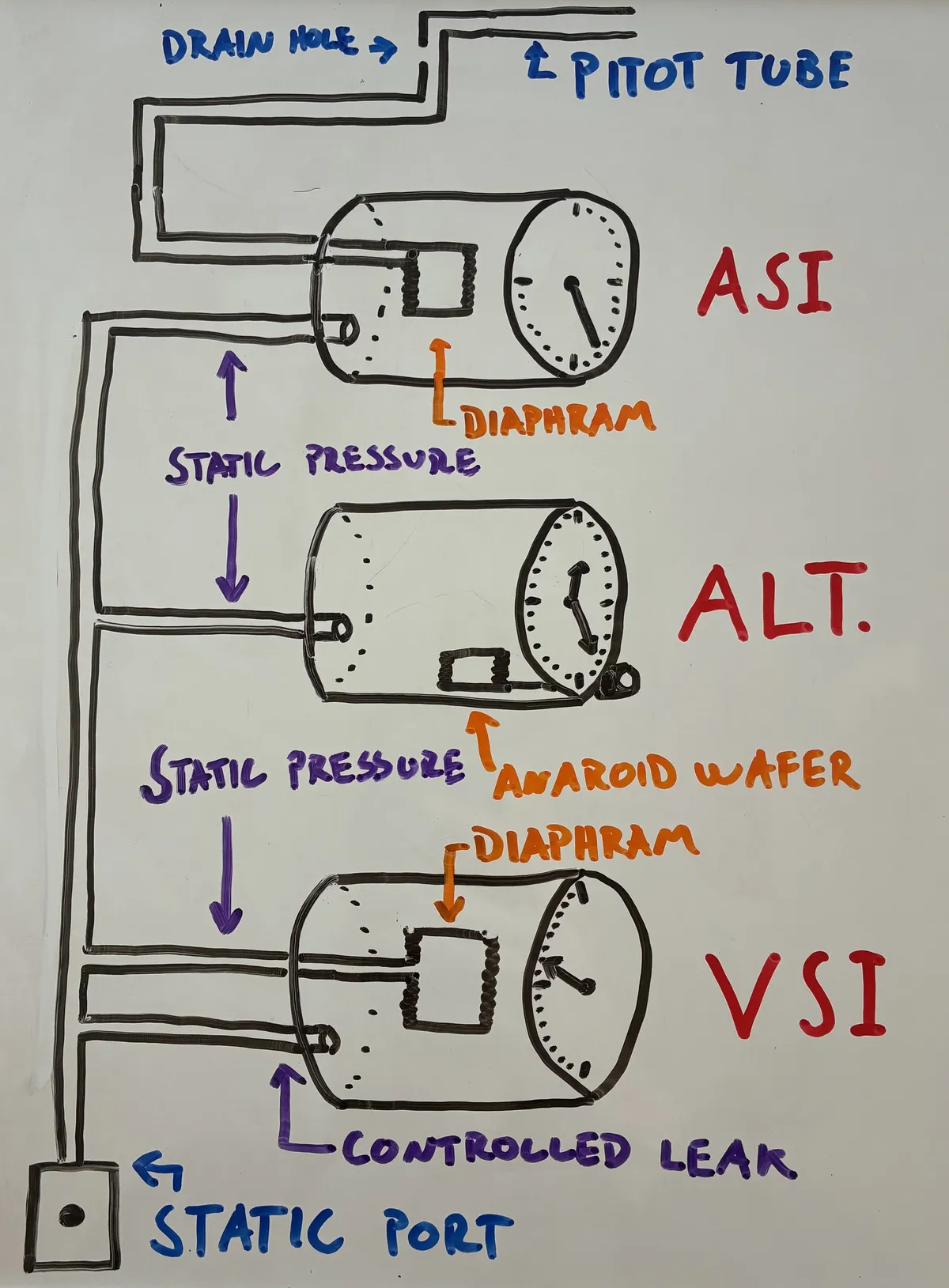
-Pitot static source, inside the cowling on the right.
-Alternate pitot static source, under the aircraft.
-Airspeed indicator; indicated airspeed, calibrated airspeed, true airspeed
- VSI
- Altimeter (altitudes, indicated, true, pressure, absolute)
Pitot system in the R22
Gyroscopic instruments
useful for certain instruments.
- functions, markings, limitations
-Principle of gyroscope, gyroscopic precession and rigidity in space.
-Gyroscope errors, D(rift)R(eal wander)A(pparent wander)T(ransport wander)T(opple)
-Power sources; vacuum system, electrical system (pros cons each)
-Attitude indicator
-Turn and slip indicator
Magnetic Compass
-Compass errors
U(ndershoot)N(orth)O(overshoot)S(outh) 30-20-10-0-10-20-30
A(ccelerate)N(orth)D(ecelerate)S(outh) due to weird CG
Magnetic dip error.
This lesson was last edited 4 weeks, 1 day ago.
Previous | Next